SaaS Paradigm Shift Matrix: The road to the delivery of the future of software
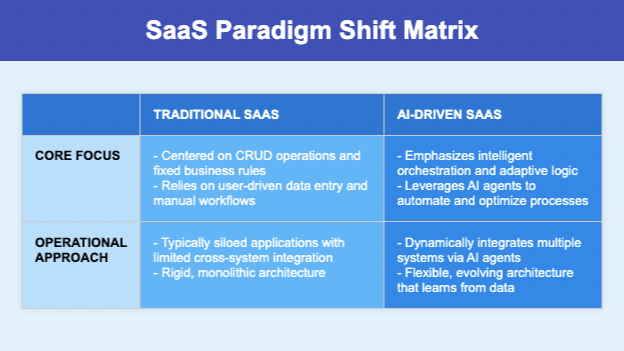
In the rapidly evolving landscape of enterprise technology, Software as a Service (SaaS) continues to dominate. However, the next wave of SaaS solutions is emerging, fueled by artificial intelligence and a shift toward adaptive, data-driven operations. To help illustrate this evolution, let me introduce what I call “The SaaS Paradigm Shift Matrix,” a simple 2×2 framework for comparing Traditional SaaS models with AI-Driven SaaS offerings.
1. Core Focus Even if Traditional SaaS mainly focuses on creating, reading, updating, and deleting actions on business rules very solidly defined within a software application, still, users will have to confront much more manually entered data with frequent interchanges between modules and systems. In contrast, AI-Driven SaaS is far from user-intensive processes. It places AI agents at the helm to manage and optimize workflows autonomously. Instead of having rules hardcoded in, intelligence evolves on real-time data, allowing for more adaptive and proactive decision-making.
2. Operations Approach Traditionally, SaaS solutions work in silos. Each tool has its own architecture, which causes data flow to be limited and creates fragmented user experiences. Scaling or updating systems requires a lot of development effort in many cases. Interoperability and data-driven orchestration are also highlighted in AI-Driven SaaS. AI agents can seamlessly bridge disparate applications so that information can be automatically pulled and analyzed from different sources. It also has architecture for continuous learning to adapt fast in changing business or market conditions.
Why It Matters Now
Evolving Customer Expectations: Clients and end-users expect seamless experiences and real-time insights. AI-driven platforms can meet these needs more effectively than traditional point solutions. Scalability and Adaptability: With growth in business, processes have to scale without having to retool the whole system. AI-driven SaaS adapts by dynamically adjusting rules and data flows. Competitive differentiation: An intelligence orchestration coupled with predictivity for providers amidst crowded SaaS offerings.
How to Prepare
Audit Your Current Stack Identify where data silos exist and how they're hindering your workflows. Invest in AI and Data Infrastructure: Lay the foundation for machine learning initiatives, ensuring data is clean, well-structured, and accessible. Foster partnerships between technical teams, data scientists, and business stakeholders, including those who have to design the AI: Adopt a collaborative mindset.
Final Thoughts
The evolution from Traditional SaaS to AI-Driven SaaS is already underway, and businesses that embrace this shift can unlock significant efficiency gains and discover new opportunities. Using The SaaS Paradigm Shift Matrix as your guide, take a critical look at your existing processes, infrastructure, and strategic goals to determine how AI can reshape your approach to software delivery and consumption. By focusing on adaptive intelligence and orchestration—versus purely transactional operations—organizations will be better positioned to harness the full potential of AI, remain competitive, and ultimately drive greater value for both their customers and their bottom line.
By : Suvayu K Chakraborty
References :
Soni, N., Sharma, E. K., Singh, N., & Kapoor, A. (2019). Impact of Artificial Intelligence on Businesses: from Research, Innovation, Market Deployment to Future Shifts in Business Models. In arXiv (Cornell University). Cornell University. https://doi.org/10.48550/arxiv.1905.02092